
The bays are full. The phone hasn't stopped since seven. Someone's called in sick, so the owner is in the bay instead of the office. The review requests don't go out. The Monday email gets skipped, just this week. Nobody posts anything, because who has time?
It feels fine. Six weeks later, it isn't.
Consistent marketing works because it builds on itself: every review, post, email and reminder makes the next one work a little harder, and every time you stop, you start again from cold.
That's why the workshops that stay busy aren't the ones who market hardest when the phone goes quiet. They're the ones who never stopped.
Key takeaways
- A quiet week is usually made on a busy one: the week the marketing stopped.
- Consistent marketing compounds. Stop/start marketing resets the clock every time you stop.
- Consistency isn't more work. It's a rhythm you set up once, while you're busy, so it runs without you.
Stop/start marketing waits for the warning light
The marketing that fills next month's diary gets done, or doesn't, while this month is flat out.
We've already covered what to do when your workshop goes quiet. This is the other half: how to stop it happening in the first place.
You'd never tell a customer to wait for the warning light before booking a service. You'd tell them to service it on schedule, so the light never comes on. Stop/start marketing is waiting for the warning light.
Most workshops run their marketing that way. Quiet week, go hard. Bays fill up, stop. Quiet again a couple of months later, go hard again. Each time it feels like the marketing worked, because the phone picked up. What it actually did was refill a hole it helped dig.
We know the pattern because we've run our own workshop since 2015, and for a long time it ran exactly like that. The problem was never effort. It was rhythm.
What builds up when you keep going
Consistent marketing compounds, because every piece makes the next one land a little easier.
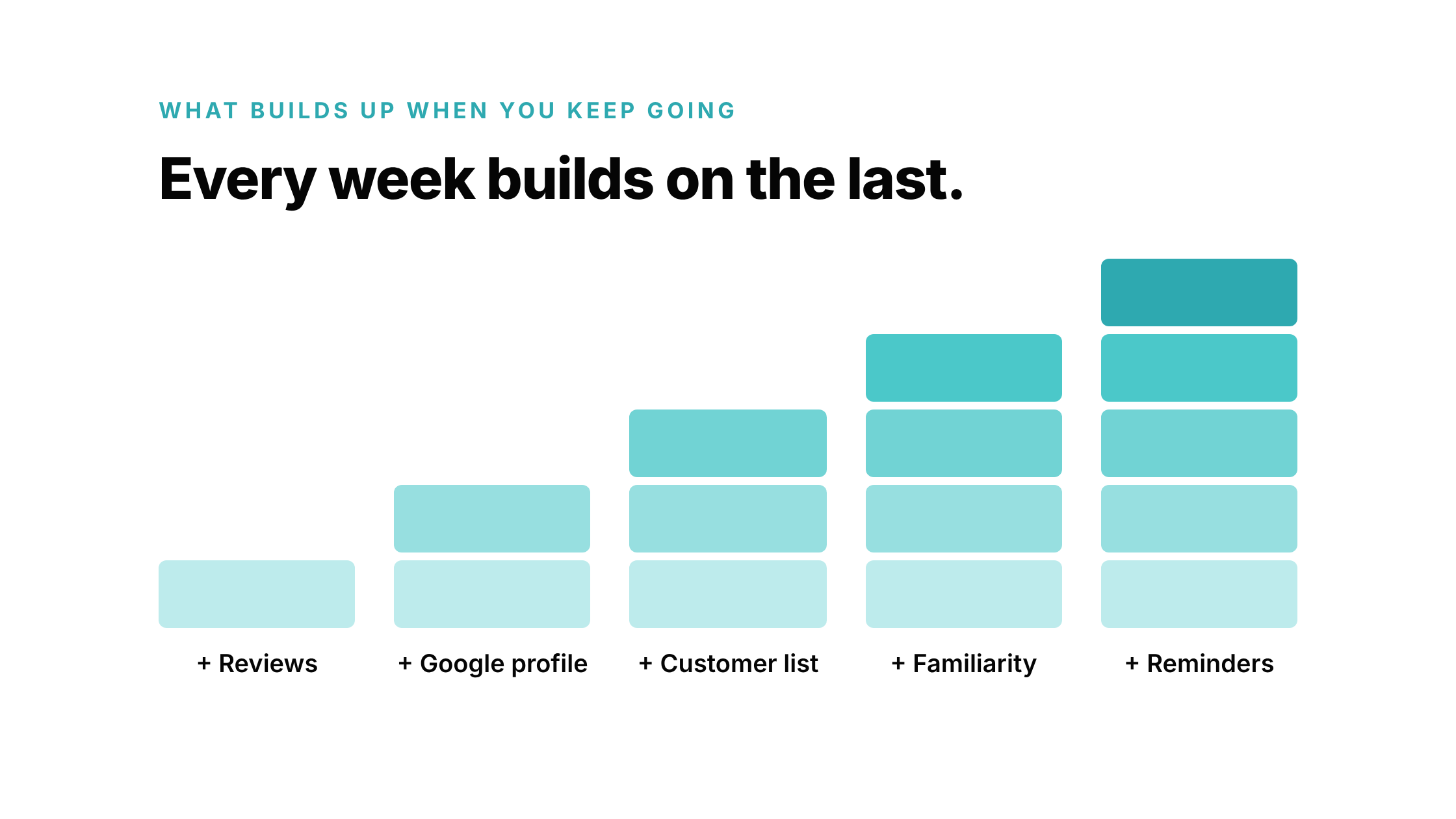
Here's what quietly stacks up in a workshop that keeps showing up:
- Reviews. A steady trickle after every job, not a burst from last March. People notice when the newest review is eight months old.
- Your Google Business profile. Recent photos, recent posts, questions answered. It's a big part of how locals find your workshop on Google, and it looks like a workshop that's open and busy, because it is.
- Your customer list. People who've been in once and hear from you every week don't drift to the workshop down the road. Nobody calls you to announce it when they stop coming. They just stop.
- Familiarity. The tenth time someone sees your name means more than the first. You'll be sick of saying it long before they've heard it.
- Reminders. Every service and recommended-work reminder that goes out on time is a booking that didn't depend on anyone remembering.
Most of your customers only need you a couple of times a year. A service, a set of tyres, a noise they can't ignore any longer. You don't get to pick when. So your marketing's job isn't to grab them on the day. It's to make sure that when the day comes, yours is the name they already know.
You can't switch that on the week you need it. It's built one week at a time.
What it costs every time you stop
Stopping your marketing doesn't pause it. It sends it back to the start.
The customer list goes cold. The reviews dry up and the profile starts to look tired. Ads that get switched off and back on have to find their feet again, and you pay for that settling-in time every time. And people forget. Not because they didn't like you. Because someone else turned up while you were gone.
There's research on this, from email. Zhang, Kumar and Cosguner studied how often one retailer should email its customers (Journal of Marketing Research, 2017). In that study, sending too few emails cost about twice as much lifetime profit per customer as sending too many. It was an American retailer, not a workshop, so don't take the numbers to the bank. The direction is the point: going too quiet hurt more than going too often.
Most workshop owners worry about annoying people with too much. Hardly any worry about being forgotten. It's usually the second one that costs you.
Why it pays most when everyone else goes quiet
When other workshops pull back their marketing, the ones still showing up are the ones people remember.
Quiet patches tend to hit a whole town at once. Ask your parts rep what the feeling is around town right now. They walk into every workshop, so they'll have a fair idea.
The workshops still flat out in a quiet patch usually aren't lucky. They kept their marketing running when they were busy, so there was work already lined up when everyone else's phone went quiet.
There's less noise, too. When other workshops stop posting, emailing and advertising, yours are up against fewer of theirs.
That's when a consistent rhythm is worth its weight in gold. It isn't doing anything special that week. It's just still there.
Consistent marketing doesn't mean more work
Consistent marketing isn't about finding more hours. It's about setting up a rhythm once, so it runs whether anyone remembers or not.
Marketing doesn't stop in a busy week because anyone's lazy. It stops because it lives in someone's head, usually whoever runs the office, and that person is already doing everything else.
So take it out of their head. A steady rhythm in a workshop looks something like this:
- Service and recommended-work reminders that go out on their own.
- A review request after every job, not just the ones you're sure went well.
- One email to your customers, same day, every week.
- Real job photos on Facebook and your Google profile, batched at the start of the month. Two hours, once.
- Quotes followed up on the same day each week.
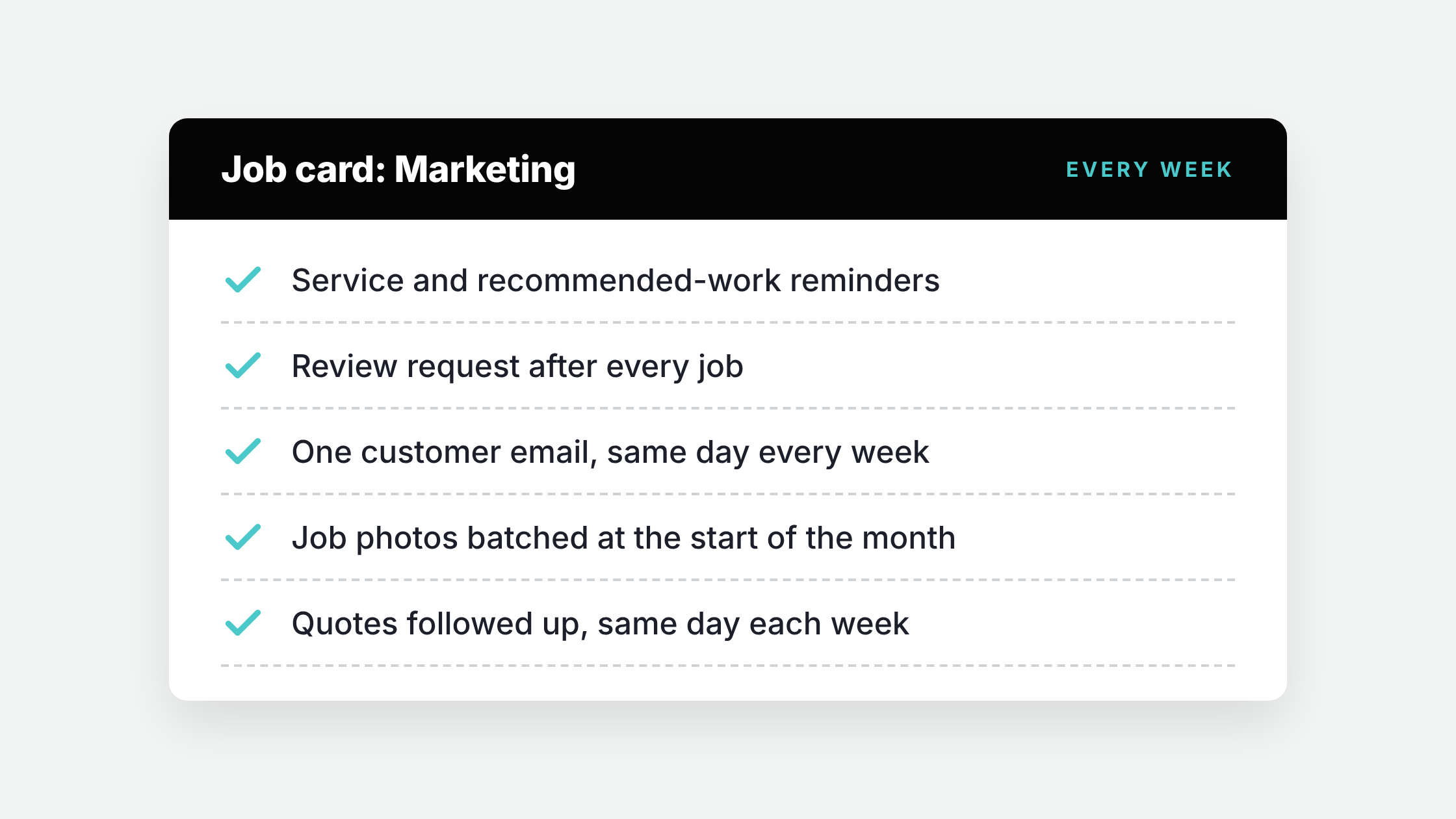
Not a task. A system.
Set it up while you're busy, because that's exactly when it has to run without you. And if the posts go out but the work doesn't come in, that's a different fix: why workshop social media often doesn't bring in bookings.
That's what clockwork looks like in a workshop. Customers come back on schedule, reviews arrive without anyone chasing them, and the phone doesn't go quiet for a week without warning.
A quick check for this week
- If next month was your busiest yet, which part of your marketing would stop first?
- When did your last Google review come in, and when did your customers last hear from you?
- Which item on that list runs without someone having to remember it?
Quiet weeks will still happen. They just won't catch you out.
Christmas will still be Christmas. School holidays will still be school holidays. Every workshop has quieter patches. Ours included.
The difference is they stop sneaking up on you. You see them coming, there's work booked through them, and you're not trying to market your way out of a hole. No scramble. No guessing. No starting from cold.
If you're in a quiet patch right now, start with What should you do when your workshop goes quiet? and grab the free guide. That's the fix for this week. This post is for every week after.
And if you'd rather the rhythm ran without you in the middle of it, that's the work we do.
Related reading
- What should you do when your workshop goes quiet? The fix for this week: who to ring first and what to say.
- You're sick of saying it, they've barely heard it Why repeating your message is what makes it stick.
- Want more local work? Start closer to home Building local visibility on Google so nearby customers find you.
- Why isn't your workshop's social media bringing in bookings? Making your posts move people closer to booking.